
Wednesday, June 26, 2013


Time is near!!
6-26-13 Still working on grades at AUS, but soon done. Accompanied by a good friend, I will walk 11 miles on 6-28-13--full backpack, walking sticks, and high energy! First fight leaves Sunday, 6-30-13' so my next entry will somewhere in Europe. Buen Camino! Love to one all.
Thursday, June 20, 2013
As part of my annual quarter away from teaching at Antioch University Seattle, I am taking a 9-week trip to a variety of European countries.
In support of discerning the focus and direction for the last third of my life, I will begin my summer travels by walking El Camino de Santiago de Compostela (The Sacred Way of St. James) in northern Spain with my Swedish brylling (cousin) Karin. We will walk for 35 days between early July and early August, 2013, planning to complete the 450 mile/790 km from St. Jean Pied-de-Port in southwestern France (near Biarritz) to Santiago in northwestern Spain (about 50 miles east of the Atlantic Ocean). Karin and I have been talking about walking a pilgrimage since first meeting each other in 2007. Our trip begins by crossing the Pyrenees Mountains—nothing like leaping headfirst into the deep end of the pool!
In support of discerning the focus and direction for the last third of my life, I will begin my summer travels by walking El Camino de Santiago de Compostela (The Sacred Way of St. James) in northern Spain with my Swedish brylling (cousin) Karin. We will walk for 35 days between early July and early August, 2013, planning to complete the 450 mile/790 km from St. Jean Pied-de-Port in southwestern France (near Biarritz) to Santiago in northwestern Spain (about 50 miles east of the Atlantic Ocean). Karin and I have been talking about walking a pilgrimage since first meeting each other in 2007. Our trip begins by crossing the Pyrenees Mountains—nothing like leaping headfirst into the deep end of the pool!
The
impetus for the timing of this trip is my attending The International Jungian Congress in Copenhagen (Köpenhamn) in mid-August. After the Congress, I will meet a friend in London. We will first complete a 5-day trek in Wales: The Pembrokeshire Coast Path. After our hike, we will return to London see the jolly old sights.
I will write now and then as I walk the Camino. You can contact me via my e-mail address for this trip: greenpen2013@gmail.com. I
do not promise timely response; I will access the internet occasionally
when I am able to keep my eyes open after a long day of hiking.
¡Buen Camino!
Ruega por nosotros, por favor!
Ruega por nosotros, por favor!
Bra Camino resa! Be för oss, tack.
Good Camino! Please pray for us.
But first, a little education!
The Camino is one of hundreds (thousands, probably!) of sacred
pilgrimage routes. The following are sources of information about our
trip.
BOOKS:
Brierley, J. (2013). A pilgrim’s guide to the Camino de Santiago. Forres, Scotland: Camino Guides.
Cousineau, P. (1998) The art of the pilgrimage: The seeker’s guilde to making travel sacred. Berkeley, CA: Conari Press.
Rupp, J. (2005). Walk in a relaxed manner. Maryknoll, NY: Orbis Books.
FILM:
Emilio Estavez’s film, The Way, also starring his father, Martin Sheen, gives a useful overview of the trip. http://theway-themovie.com/film.php
WEB SITE INFORMATION:
St.
James translates either as San Diego or Santiago. It is this latter
which gives its name to the town of Santiago de Compostela in Galicia,
Spain, the end of the most important pilgrimage route in Western Europe,
el Camino de Santiago–the full extent of which is seen below (courtesy of Wikipedia).
The church at Santiago holds the relics of St. James and has been a
pilgrimage site for over a millennium. It is considered the third most
important site in Western Christianity (after Rome and Jerusalem).
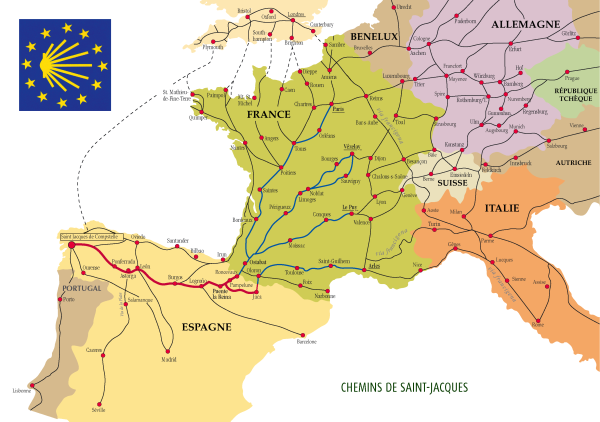
Wikipedia (http://en.wikipedia.org/wiki/Way_of_St._James)--not a valid source for graduate papers!--says the following: The Way of St. James or St. James' Way (Spanish: El Camino de Santiago, Galician: O Camiño de Santiago, French: Chemins de Saint-Jacques-de-Compostelle, German: Jakobsweg, Basque: Done Jakue bidea) is the pilgrimage route to the Cathedral of Santiago de Compostela in Galicia in northwestern Spain, where tradition has it that the remains of the apostle Saint James are buried.
HISTORY

The Way of St. James was one of the most important Christian pilgrimages during medieval times, together with Rome and Jerusalem, and a pilgrimage route on which a plenary indulgence could be earned;[1] other major pilgrimage routes include the Via Francigena to Rome and the pilgrimage to Jerusalem.
Legend holds that St. James's remains were carried by boat from Jerusalem to northern Spain where he was buried on the site of what is now the city of Santiago de Compostela.
The
Way can take one of any number of pilgrimage routes to Santiago de
Compostela. Traditionally, as with most pilgrimages, the Way of Saint
James began at one's home and ended at the pilgrimage site. However a
few of the routes are considered main ones. During the Middle Ages, the route was highly travelled. However, the Black Death, the Protestant Reformation
and political unrest in 16th-century Europe led to its decline. By the
1980s, only a few pilgrims per year arrived in Santiago. Later, the
route attracted a growing number of modern-day pilgrims from around the
globe. The route was declared the first European Cultural Route by the Council of Europe in October 1987; it was also named one of UNESCO's World Heritage Sites.
Whenever St. James's day
(25 July) falls on a Sunday, the cathedral declares a Holy or Jubilee
Year. Depending on leap years, Holy Years occur in 5, 6 and 11 year
intervals. The most recent were 1982, 1993, 1999, 2004, and 2010. The
next will be 2021, 2027, and 2032.
 Monument of the pilgrims, Burgos
The
pilgrimage to Santiago has never ceased from the time of the discovery
of St. James' remains, though there have been years of fewer pilgrims,
particularly during European wars.

Subscribe to:
Posts (Atom)